Food Choices & Body Weight
How the Daily Sequence of Meals Shapes the Body Over a Season
Eleanor Whitfield
·
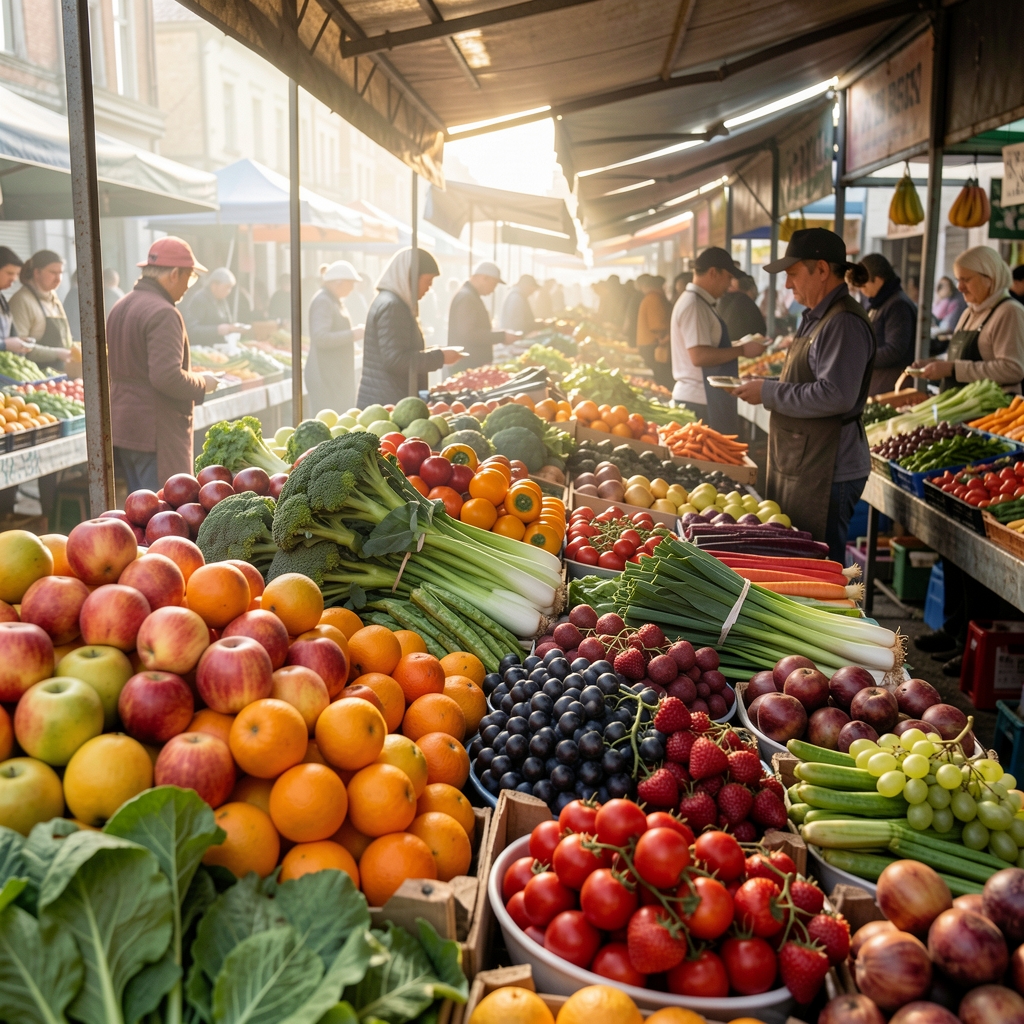
The spring market arrives differently each year. This year it came early — the first purple sprouting broccoli appearing at the end of February, the asparagus following close behind in early March. For anyone who pays attention to what grows when, the shift is unmistakable. For anyone who eats according to season, the shift in what lands on the plate follows almost automatically.
This article is an attempt to record what happens to a week of eating when it is oriented around what spring produces. Not a programme, not a directive — simply a week-long field note on what seven days of spring vegetables looks and feels like when written down.
The week began, as most do in an editorially interested household, with a Sunday shop. The brief was loose: buy what is at its best, cook with what arrives. The trolley filled with asparagus, two heads of sprouting broccoli, a bag of spinach, spring onions, a small bunch of radishes, and several lemons. A secondary bag held dried lentils, a box of eggs, some good bread.
Monday's lunch was a warm lentil salad with the first of the asparagus — griddled briefly, cut at an angle, laid over the lentils with a dressing of lemon and olive oil. It was, by any measure, a simple meal. But it had a particular quality that is difficult to describe without sounding portentous: it was satisfying in a way that left no residue. Two hours later there was no pull toward the kitchen. The appetite had been answered cleanly.
Tuesday brought the broccoli, roasted at high heat until the edges caught, eaten alongside poached eggs on toast. Wednesday offered a spinach and radish salad with a soft-boiled egg, dressed with a mustard vinaigrette sharp enough to make itself felt.
What the first half of the week established was a pattern of meals whose nutritional density — the concentration of vitamins, minerals, and dietary fibre relative to their volume — was high. The body's response to that density was a steadiness of energy through the afternoon hours that the record contrasted, without prompting, to weeks in which the same hours brought a familiar dip.
One of the most consistently documented findings in nutritional research concerns the relationship between dietary fibre and a sense of fullness between meals. Spring vegetables — asparagus, broccoli, spinach, artichokes when they arrive in late March — are among the more significant sources of dietary fibre available in this season. The record noted, without drawing any conclusion, that appetite between meals during the spring-vegetable week was quieter than usual.
This is the kind of observation that is difficult to isolate. Many variables influence appetite: sleep, stress, movement, the temperature of the day. But the pattern was consistent enough across the week to merit noting. On the days when the main meals had been built around vegetables — when they occupied the largest portion of the plate rather than a supplementary role — the intervals between meals were longer and less preoccupied.
By Thursday the initial enthusiasm for the week's project had settled into something more ordinary. This is normal. A week of intentional eating tends to begin with heightened attention and soften into habit by its midpoint. What the record noted on Thursday was that the habit had formed — not of eating spring vegetables because of a project, but simply of reaching for them because they were there and because the meals built around them had been, in a word, good.
Thursday's dinner was a spring onion and asparagus frittata — eggs beaten with a little cream, the vegetables briefly softened in butter, the whole thing finished in the oven. A simple dish. It took twenty minutes. The record noted that it was eaten slowly, at the table, with a glass of water, and that the meal felt complete in a way that faster meals rarely do.
Friday brought a return to the market. The radishes had been finished. More spinach was needed. A bunch of watercress had appeared that had not been there on Sunday — its season was beginning. The record noted the watercress acquisition with a small notation: "peppery, intense, excellent with eggs." It found its way into Saturday's breakfast.
By the end of the week, the writer noted that he felt lighter. Not in any dramatic sense — not in a way that a scale would have confirmed by a meaningful figure. But lighter in the sense of less accumulated: less weighted by the texture of meals that leave a residue, less aware of the body in the way one becomes aware of it when it is uncomfortable.
This is a subjective experience, and the article makes no claim beyond the subjective. But the experience was consistent with what the nutritional record showed: a week in which the dietary fibre intake was high, the vegetable variety considerable, the reliance on processed ingredients low, and the cooking mostly simple and from scratch. The body, meeting those conditions, found its own level quietly.
Plant-based meals — or meals in which plants occupy the central rather than supplementary role — have a particular relationship to weight balance that is frequently discussed in nutritional literature in aggregate terms. What is less often described is the weekly experience of eating this way. The aggregate finding is confirmed not by dramatic events but by weeks like this one: ordinary weeks in which nothing dramatic happens, the plate changes incrementally, and the body adjusts in the same measure.
One dimension of the spring vegetable week that the record could not fully account for numerically was the act of cooking itself. Every meal described above was prepared at home, from whole ingredients, with modest equipment and modest time. The asparagus took eight minutes. The frittata took twenty. The lentil salad, including cooking the lentils, took thirty-five minutes.
The significance of home cooking to nutritional awareness is not only the control it offers over ingredients and portions. It is the attention it requires. To cook a meal from whole ingredients is to engage with the food before it is eaten — to decide, at each step, what will go in and in what proportion. That engagement is itself a form of nutritional awareness. It precedes the meal. By the time the food arrives on the plate, it has already been considered.
The spring vegetable week was, in this sense, as much an exercise in cooking as in eating. The two are not separable. The record ended on Sunday with a note that was less about vegetables and more about the week as a whole: "The kitchen was used more than usual. The results were simple. Nothing was remarkable. Everything was good."
Articles published on Taleni Quarterly are editorial in nature and reflect the writers' observations on everyday nutrition practices and weight awareness. The content is not intended as professional advice, nor as guidance for the management of any specific condition. Readers with specific concerns about their daily routines are encouraged to speak with a qualified wellness professional.